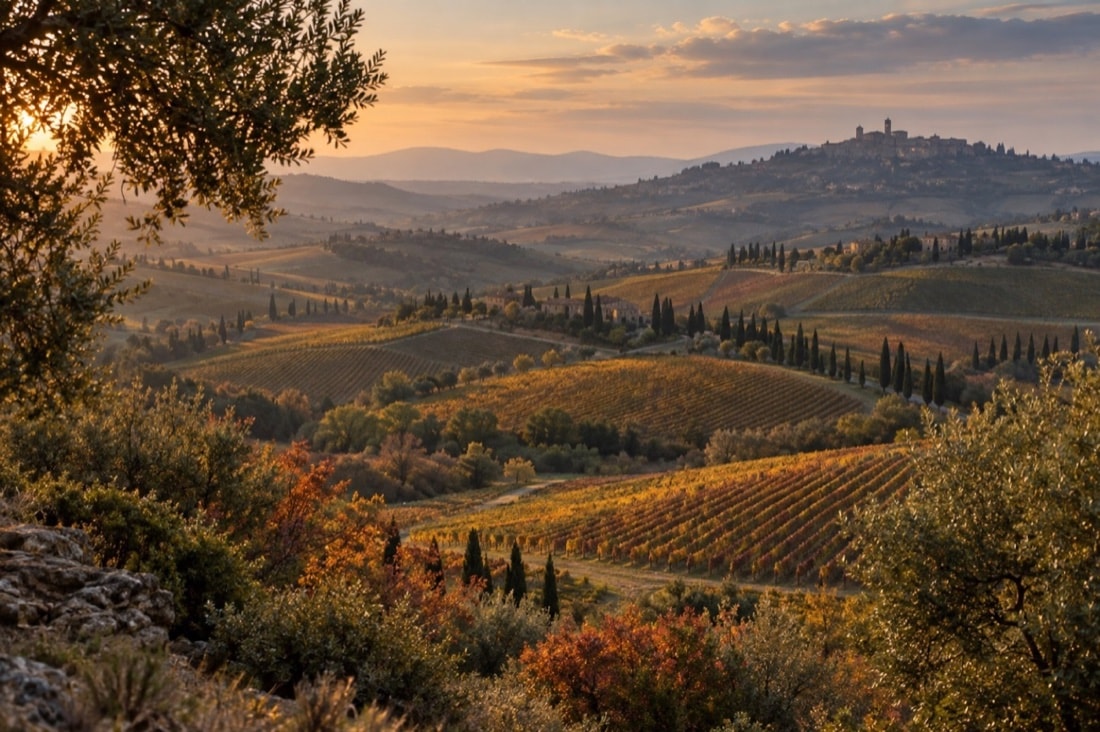
Montalcino is among Tuscany’s best-known wine territories, but its name should not flatten the landscape. Vineyards occupy hills with different elevations and exposures, interrupted by woodland, olive groves, fields and Mediterranean scrub. Those variations influence temperature, wind, water and the pace at which Sangiovese ripens.
Sangiovese inside a defined origin
Brunello di Montalcino is made from Sangiovese, traditionally called Brunello in this area. The Brunello consortium’s guide sets out the production territory and principal appellation rules. The discipline belongs to the origin as a whole; it does not describe how every individual vineyard is farmed.
Sangiovese is responsive to site and season. A high, open slope develops under different day and night temperatures from a sheltered lower parcel. Clay-rich, calcareous and sandier soils store and release water differently. Woodland edges alter shade and air movement. Regional description becomes useful only when these conditions remain visible.
Organic and biodynamic work
Ground cover can protect structure, slow erosion and provide habitat. During dry periods it may also compete with vines for water. Mowing, rolling or cultivating are therefore strategic choices rather than signs of a fixed ideology. Compost needs similarly careful placement on sloping land.
Biodynamic preparations and agricultural calendars add another layer, but weather and vine development retain immediate authority. A humid year raises fungal pressure; a hot, windy year changes water demand and sun exposure. The method proves itself through its response to those conditions.
Scrub, herbs and restraint in description
Rosemary, thyme, lavender and other aromatic plants are familiar parts of Tuscan scrub. They contribute to habitat and the visual character of the hills. Their presence should not be used as a literal recipe for wine aroma. Sensory character emerges from grape material, site, season, fermentation and maturation, not from poetic proximity alone.
A concise historical note
One property in this landscape, Corte Pavone, passed from the Martini family, who held it from around 1940, to Terre Bindella in 1988, and then to the Loacker family in 1996. That documented ownership sequence belongs to the regional record. It is stated here in the past tense and without carrying old vineyard sizes, grape percentages or ageing schedules forward as facts about an active business.
Cellar choices within the appellation
The appellation provides a framework for origin and maturation. Within it, fermentation temperature, extraction, cask size and oxygen exposure remain consequential. Large oak and small barrels do different work; neither is an automatic measure of authenticity. The independent cellar-practice guide explains those variables.
For the regional Italian and German versions, see Montalcino e Brunello and Montalcino und Brunello. The wider Tuscany comparison places the hill territory beside the coastal Maremma.